Complete Guide to PTFE Packing Selection
In industrial production, the choice of sealing materials directly affects equipment operating efficiency and production safety. PTFE packing, as a high-performance sealing material, has become an indispensable component in industries such as chemical, pharmaceutical, and food processing due to its unique chemical stability and physical properties. This article systematically introduces the types, performance characteristics, and selection considerations of PTFE packing, helping engineers make reasonable choices based on actual operating conditions.
PTFE packing is primarily made from polytetrafluoroethylene (PTFE) and woven through different manufacturing processes. PTFE itself has extremely strong chemical inertness, which enables PTFE packing to remain stable in the vast majority of chemical media. Specifically, except for a few alkali metals such as sodium and potassium in molten state, PTFE packing almost does not chemically react with any substance.
From the perspective of physical performance, PTFE packing has three notable advantages: first, excellent tensile strength, allowing it to withstand considerable mechanical stress without breaking; second, self-lubricating properties, which significantly reduce the friction coefficient of the sealing surface and lower power loss; third, good thermal conductivity, ensuring that even in high-speed operations with line speeds reaching 20 m/s, the packing will not fail due to overheating and can guarantee long-term continuous operation of the equipment.
These fundamental properties determine the applicability of PTFE packing under harsh conditions such as high temperature, high pressure, and strong corrosion, and also lay the foundation for its widespread use in multiple industrial fields.
According to differences in raw material formulation and manufacturing process, PTFE packing can be divided into various types, each with specific applicable ranges and performance focuses.
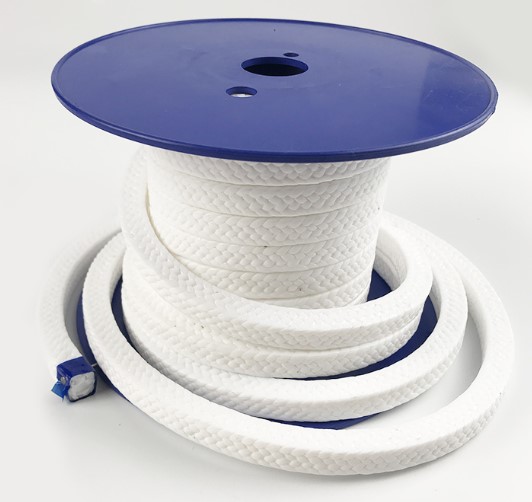
Pure PTFE packing uses pure PTFE dispersion resin as raw material, first forming raw material films, and then weaving them into braided packing. This packing does not add any other substances, preserving the pure characteristics of PTFE. Due to its high cleanliness, this packing is especially suitable for industries with strict hygiene requirements such as food, pharmaceuticals, paper, and chemical fibers, as well as for valves and pumps handling highly corrosive media.
Technical parameters: Maximum operating temperature: 260°C; Maximum operating pressure: 2.0 MPa; Applicable pH range: 0–14.
It should be noted that although pure PTFE packing has excellent chemical stability, its mechanical strength is relatively low, making it unsuitable for high-pressure or high mechanical stress conditions.
This packing is woven from stretched and reinforced PTFE fibers and impregnated with PTFE emulsion. The stretching and reinforcement process significantly improves material strength while maintaining a low friction coefficient. Because PTFE products inherently have poor thermal conductivity and high thermal expansion, this type of packing is more suitable for rotary parts at relatively low line speeds, usually recommended at speeds below 4 m/s.
Its pressure resistance is superior to pure PTFE packing, with a maximum operating pressure of 6.3 MPa. The temperature and pH applicability ranges are the same as pure PTFE packing. In selection, if the equipment speed is not high but pressure is relatively high, this packing is a more economical and practical choice.
Graphite-PTFE packing is woven by adding graphite particles to PTFE lines. The addition of graphite brings three improvements: first, increased tear strength; second, enhanced thermal conductivity; third, further reduced friction coefficient. These improvements give this type of packing longer service life and more stable sealing performance.
This packing is particularly suitable for pump shaft sealing and can also be used for sealing media such as water, steam, and solvents in agitators, mixers, thermal presses, and centrifugal pumps. In scenarios requiring both corrosion resistance and heat dissipation, graphite-PTFE packing performs exceptionally well.
Aramid fiber PTFE packing is woven from aramid fibers impregnated with PTFE emulsion and lubricants. Aramid fibers themselves have extremely high strength and modulus, known as “artificial metal fibers,” which provide the packing with excellent high-speed and high-modulus characteristics. Compared with other types of packing, aramid packing better resists particulate-laden media and higher temperatures.
This packing has excellent chemical resistance, high resilience, and low cold flow properties. It can be used alone or in combination with other packings. On pump systems, it is an ideal replacement for traditional asbestos packing, with the most prominent performance being high strength while maintaining good ease of installation and removal. It is widely applied across industries, especially performing well in media containing solid particles.
This packing combines the advantages of aramid fibers, carbon fibers, and PTFE fibers through a blended weaving process. It fully utilizes the strengths of different materials to achieve performance that single-material packing cannot reach. It is mainly used for sealing rotating pump shafts, especially suitable for high-pressure, high-load equipment.
Under extreme conditions, such as the simultaneous presence of high pressure, high temperature, and corrosive media, blended packing generally has a longer service life and more reliable sealing effect than single-material packing.
Linen-PTFE packing uses natural fibers such as jute and linen as the base, pre-impregnated with PTFE emulsion, and during square weaving is further impregnated with special PTFE emulsion and barrier agents. This process gives it good sealing, lubrication, and chemical resistance.
As a universal packing for pumps and valves, it is suitable for most media except strong acids, strong alkalis, and strong oxidizers. It is widely used on rotary pumps, plunger pumps, valves, and mixers, making it a cost-effective general-purpose sealing material.
Selecting the appropriate PTFE packing requires comprehensive consideration of multiple factors. Incorrect selection can lead to seal failure, equipment damage, and safety incidents. The following six dimensions must be carefully evaluated during selection:
- Temperature Conditions: Accurately assess operating temperature, including normal and potential extreme temperatures. Although most PTFE packing has a maximum temperature of 260°C, a safety margin is recommended. For frequently fluctuating temperatures, types with lower thermal expansion or better heat conduction, such as graphite-PTFE packing, should be prioritized.
- Chemical Compatibility: Analyze the types and concentrations of chemicals the packing will contact. While PTFE is resistant to most chemicals, certain highly corrosive or special media may require specially formulated PTFE packing. For example, in strong oxidizing media, specially treated packing may be required.
- Pressure Conditions: Understand both static and dynamic pressures. For high-pressure applications, reinforced PTFE packing such as aramid-PTFE provides additional strength and durability. For conditions with fluctuating pressure, expanded PTFE is more suitable due to its flexibility.
- Mechanical Stress: Consider mechanical forces on the packing, especially in dynamic applications involving motion, vibration, or impact. For high mechanical stress, braided PTFE or fiber-reinforced packing is more appropriate. High-speed rotary equipment requires careful attention to wear resistance and tensile strength.
- Environmental Factors: Evaluate humidity, UV exposure, and abrasive media. In outdoor or high-UV environments, packing with superior aging resistance is needed. For abrasive media containing solid particles, PTFE fiber or aramid-blended packing is often selected for its wear resistance.
- Equipment Type and Motion: Different equipment types have different packing requirements. Turbine pumps, centrifugal pumps, rotary pumps, and reciprocating pumps generate different frictional heat and mechanical stress. Additionally, dryers, mixers, and agitators have varying motion modes, requiring packing with corresponding characteristics.
The widespread industrial use of PTFE packing is due not only to its excellent sealing performance but also to its significant economic benefits.
In terms of application range, PTFE packing is suitable for almost all types of pumps, including turbine, centrifugal, rotary, and reciprocating pumps. It is also applicable to dryers, mixers, agitators, and valves. This wide applicability allows companies to simplify spare parts management and reduce inventory variety.
From an economic perspective, although PTFE packing’s initial cost may be higher than some traditional packings, its long service life significantly reduces downtime and costs associated with frequent replacement. Unplanned equipment shutdowns can cause enormous losses, and reliable sealing is crucial to prevent downtime. Additionally, the low friction coefficient of PTFE packing helps reduce energy consumption, resulting in considerable savings during long-term operation.
From a safety standpoint, the chemical stability of PTFE packing ensures that even in unexpected situations, it does not react dangerously with the media. For equipment handling toxic, hazardous, or expensive media, reliable sealing is critical to prevent environmental contamination and material loss.
To ensure optimal performance of PTFE packing, attention should be paid to the following during installation and operation:
Ensure precise matching between packing size and stuffing box to avoid leakage or excessive wear. Avoid scratching the packing surface during installation to maintain structural integrity.
Establish a regular inspection system during operation, especially under high-load conditions, monitoring wear and sealing effectiveness. Adjust promptly in case of leakage but avoid over-tightening to prevent accelerated sleeve wear.
In high-temperature applications, verify that the selected packing has the appropriate thermal rating and apply cooling measures if necessary. For long-term operation, compatible lubricants can reduce friction and extend service life.
Maintain replacement records and analyze packing lifespan under different positions and conditions to provide data support for future selection optimization.
As a vital sealing material in modern industry, the quality of PTFE packing selection directly affects equipment efficiency and production cost. By understanding the characteristics of different types of PTFE packing, fully evaluating temperature, pressure, media, mechanical stress, and other operating conditions, and making reasonable choices based on equipment type, sealing reliability can be significantly improved and maintenance costs reduced.
With advances in material technology, PTFE packing performance continues to improve. Procurement and engineering personnel should stay informed about new materials and processes, optimizing sealing solutions in a timely manner to ensure both operational safety and economic benefits. Correct selection is not only a technical matter but also a reflection of management intelligence, deserving in-depth study and practice by every industrial practitioner.
