Valve Packing Installation and Torque Control
In industrial production, valves are critical devices used to control fluid flow. Statistics show that most industrial leaks originate from valve systems. Leakage not only causes raw material waste and economic losses but also leads to environmental pollution and safety hazards. Therefore, proper installation and maintenance of valve packing is an essential part of cost reduction and efficiency improvement for enterprises.
Valve packing is located in the stuffing box between the valve stem and the valve body. Its function is simple in principle: it must allow the valve stem to rotate or move up and down freely while preventing the process medium (liquid or gas) from leaking along the stem. Although the concept is simple, achieving reliable sealing requires precise technical control.
In recent years, with advances in material science, valve packing has developed significantly in both design and materials. Whether traditional braided packing or modern molded ring packing, both can provide reliable sealing performance under various working conditions. However, to fully utilize these advanced materials, correct installation methods and proper torque control are essential.
How Torque Is Converted into Sealing Force: When installing valve packing, technicians tighten the gland nuts using a wrench. This rotational force generates torque, which is converted through threads into axial force, pushing the gland downward and compressing the packing. Once compressed, the packing undergoes two dimensional changes: it shortens axially and expands radially. This radial expansion allows the packing to tightly contact both the stuffing box wall and the valve stem surface, forming a dual sealing structure. At the same time, internal stress is generated within the compressed packing, which resists the pressure of the pipeline medium and prevents leakage through the packing structure.
Relationship Between Friction and Operating Performance: The radial pressure exerted by packing on the valve stem generates friction. When the valve operates, the stem must overcome this friction to move. For electric or pneumatic valves, this friction directly affects actuator selection and energy consumption. Excessive friction may cause the valve to operate with difficulty or even seize. Conversely, insufficient friction may result in poor sealing. Therefore, the goal of torque control is to maintain sealing performance while keeping friction within an acceptable range.
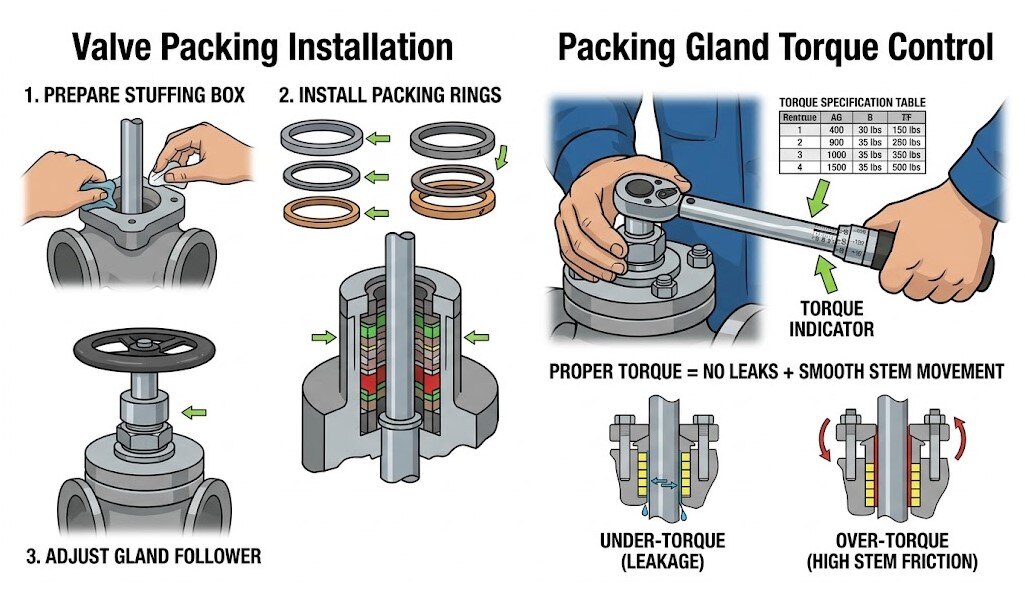
Understanding how torque transforms into sealing force leads to a key conclusion: torque must be controlled within a reasonable range. In practice, operators often fall into two extremes—over-tightening due to leakage concerns or under-tightening to avoid equipment damage. Both approaches can lead to serious consequences.
Many operators believe that tighter is safer. In reality, over-tightening leads to multiple issues:
- Excessive stem friction: Makes valve operation difficult, overloads electric actuators, and may even prevent valve movement, affecting production safety.
- Over-compression of packing: Causes loss of elasticity and significantly shortens service life. It also consumes the adjustment allowance of the gland.
- Material damage risk: High pressure accelerates aging and increases the risk of extrusion, especially under high temperature and pressure conditions.
Insufficient torque is equally dangerous:
- Immediate leakage: Medium leakage occurs right after installation.
- Packing loosening: Over time, the packing loses density and sealing effectiveness.
- Blow-out risk: Under high pressure, loosely installed packing may be forced out by the medium, causing severe leakage accidents.
- Installation of Braided Packing: Braided packing is the most traditional and widely used type. It is made of fibers woven into rope-like or strip-like structures. Its installation is relatively simple: gradually tighten the gland nuts while observing resistance. The process relies heavily on operator experience, and tightening levels may vary between individuals.
- Installation of Molded Ring Packing: Molded ring packing is an engineered product, with each ring manufactured to precise dimensions. It requires higher installation accuracy. A calibrated torque wrench must be used, and tightening must follow manufacturer-recommended torque values. Bolts and nuts should be fully lubricated to reduce friction influence on torque transmission. Regardless of packing type, thread condition significantly affects performance. Corrosion, scratches, burrs, or contamination can increase thread friction, leading to inaccurate load transfer to the packing.
- Challenges Caused by Temperature Cycling: Many industrial processes involve temperature fluctuations. Equipment heats up during startup and cools down during shutdown. Different materials have different thermal expansion coefficients, meaning valve body, stem, packing, and bolts expand and contract at different rates. This mismatch leads to gradual loss of gland load. Even properly tightened nuts may lose significant preload after several thermal cycles, which is why valves often begin to leak after some operation time and require retightening.
- Working Principle of Belleville Washers: A Belleville washer is a conical spring resembling a disc. It is installed under the nut or bolt head. When the nut is tightened, the washer is compressed and stores elastic energy. When thermal expansion and contraction occur, the washer compensates by absorbing or releasing deformation, helping maintain a more stable gland load. It acts like an “automatic regulator” for the sealing system, significantly slowing down load loss. An additional advantage is that load conditions can be estimated by measuring the washer stack height, which is more reliable than relying solely on torque readings.
Since both excessive and insufficient torque cause problems, determining the correct torque value must be based on engineering principles rather than experience alone. Torque calculation is a systematic process based on multiple parameters.
To determine proper bolt torque, the following factors must be considered:
- Packing cross-sectional size: Larger packing requires higher compression force.
- Bolt diameter: Larger bolts can carry higher loads, but also generate greater axial force for the same torque.
- Packing type: Different materials require different compression stresses.
- Sealing pressure: Higher internal pressure requires higher preload.
- Number of bolts: Total load is distributed among all bolts.
The calculation involves several steps:
- Packing area calculation: The packing cross-sectional area is calculated as: (Stuffing box diameter² − stem diameter²) × π / 4
- Total load calculation: Multiply the area by the manufacturer’s recommended sealing stress.
- Load per bolt: Divide total load by the number of bolts.
- Torque calculation: Torque = K factor × bolt load × bolt diameter
The K factor represents thread friction, typically around 0.2, but varies depending on lubrication and thread condition. Friction reduces effective preload, meaning high friction can result in insufficient sealing force even if torque readings are correct.
Even with correct torque values, installation quality depends heavily on component condition. Poor thread condition, corrosion, or improper tools can invalidate calculations. Therefore, thorough inspection is essential before installation.
- Gland yoke: Check for deformation; ensure hardened washers are used to prevent galling.
- Gland follower: Clean thoroughly to remove corrosion and debris.
- Bolts or studs: Replace if corroded, stretched, or damaged; clean old lubricant and dirt.
- Nuts: Ensure smooth movement along full thread length.
- Washers: Must be intact and hardened.
- Torque wrench: Must be calibrated and accurate.
Thread lubrication is essential because it:
- Reduces friction for accurate torque conversion
- Prevents thread seizure during disassembly
- Reduces corrosion and extends fastener life
Common lubricants include grease with graphite or anti-seize compounds. Lubricants should only be applied to threads, not packing materials, as contamination may damage sealing performance.
- Basic Preparation: Clean all nuts and bolt threads thoroughly and check for damage. Manually thread nuts along the full length to confirm smooth movement. Ensure washers are used for uniform load distribution. Verify that the gland fits properly into the stuffing box without interference and that contact with the packing is even.
- Tightening Process: Hand-tighten all nuts evenly to establish initial contact. Use a torque wrench and apply torque gradually in stages, following manufacturer recommendations. For example, if total compression is 4 mm, apply it in 3 stages of 1–1.5 mm each. Repeat tightening cycles at least three times to ensure uniform compression. Alternating tightening is essential to prevent gland tilting.
- Verification and Adjustment: Measure gland-to-body distance to ensure uniform compression. Operate the valve through full stroke to confirm smooth movement. After at least five open/close cycles, recheck and adjust gland nuts to compensate for initial settling.
Once installed and in service, valve maintenance continues. Valves experience repeated cycling, temperature fluctuations, and material aging, all of which gradually reduce gland load. Therefore, operational maintenance is as important as initial installation.
After commissioning, preload decreases due to:
- Stem movement wear
- Packing creep under long-term compression
- Thermal cycling effects
These factors may eventually lead to leakage. Simply retightening to original torque is not always effective.
Because thread conditions may change over time, torque alone is not a reliable indicator. Better methods include:
- Measuring gland height: Restore original installation position.
- Monitoring Belleville washer height: Determine load condition.
- Observing leakage behavior: Make gradual adjustments instead of over-tightening.
During readjustment, torque control is even more critical than during initial installation, since over-compression can easily damage already-settled packing.
Valve packing installation may appear simple, but it involves many technical details. Achieving long-term reliable sealing requires attention to the following:
- Proper preparation: clean and inspect all components and ensure lubrication
- Accurate calculation: determine torque based on geometry, material, and pressure
- Reliable tools: use calibrated torque wrenches
- Correct operation: apply torque in stages and verify uniformity
- Dynamic maintenance: monitor and adjust during operation using actual measurements rather than torque alone
- Smart engineering: use Belleville washers under thermal cycling conditions to improve stability
Modern valve packing materials can provide excellent sealing performance, but only when combined with correct installation and maintenance practices. Mastering scientific torque control is essential for maintenance personnel and engineers. Only then can leakage reduction, environmental protection, cost savings, and operational safety truly be achieved.
