Metal-Graphite Gasket Selection: Spiral Wound vs. Corrugated
In industrial piping systems and pressure vessel sealing applications, metal-graphite spiral wound gaskets (SWGs) and metal-graphite corrugated gaskets are two widely used sealing components. Both belong to the category of semi-metallic composite gaskets, combining the mechanical strength of metal materials with the sealing performance of flexible graphite. However, significant differences exist in structural design philosophy, mechanical behavior, and engineering application suitability.
Spiral wound gaskets are widely recognized as universal sealing components due to their excellent adaptability and balanced performance. Corrugated gaskets, on the other hand, are more specialized products designed for high reliability sealing under complex operating conditions. Understanding the technical characteristics of both is essential for achieving optimal sealing performance and operational safety.
This article provides a systematic technical comparison of these two metal graphite gasket types from structural principles, performance characteristics, application scenarios, and installation considerations, helping engineers and technical personnel make scientifically sound selection decisions.
The performance of a gasket fundamentally depends on its structural design and manufacturing quality. Although both spiral wound and corrugated gaskets follow the composite concept of metal skeleton plus flexible graphite sealing layer, the engineering realization methods are quite different.
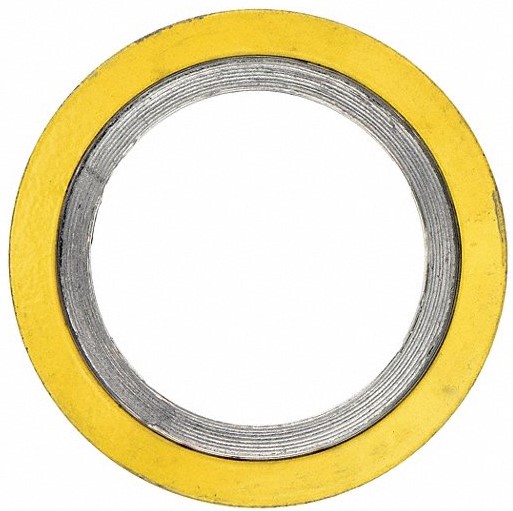
Spiral wound gaskets are manufactured using a helical winding process. V-shaped, U-shaped, or W-shaped metal strips are alternately wound with flexible graphite tape around a central mandrel.
Common metal materials include high-quality stainless steels such as SUS304 and SUS316. Depending on specific operating environments, alloy steels or special corrosion-resistant alloys may also be selected.
After winding, the metal strip is spot-welded at both the beginning and the end to prevent structural loosening during transportation or installation.
The structural density of the gasket can be adjusted according to bolt preload requirements. By controlling winding tightness, engineers can regulate compression ratio and elastic recovery performance.
Spiral wound gaskets are typically classified into three types: inner ring type, outer ring type, and inner-outer ring type.
The inner ring primarily functions as an anti-buckling stabilizer, preventing inward collapse of the gasket under high-pressure conditions. The outer ring serves as a compression limiter, ensuring proper installation position and preventing excessive deformation during tightening.
The metal strip acts as a structural framework that provides mechanical strength and load-bearing capacity. Flexible graphite fills the interlayer spaces, forming multiple micro-sealing barriers. This alternating multi-layer design enables each metal-graphite combination layer to function as an independent sealing line, significantly improving redundancy and reliability.
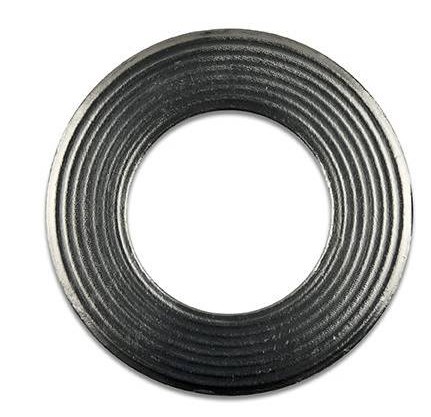
Corrugated gaskets are designed based on a different engineering philosophy. The core structure consists of a concentric wave-shaped metal skeleton combined with a composite graphite layer.
The metal skeleton is formed through precision stamping or rolling processes, creating continuous concentric corrugations on the surface. These grooves may adopt V-shaped, trapezoidal, or arc-shaped profiles. Tooth arrangement can be either aligned or staggered depending on design requirements.
Corrugated gaskets are generally divided into three structural forms:
- Basic type
- Positioning ring type
- Spacer strip type
The basic type is mainly used for male-female flange sealing surfaces. The positioning ring type is suitable for flat flange structures and helps control compression displacement. Spacer strip types are used in special engineering environments requiring precise flow channel control.
During manufacturing, thin metal sheets are first stamped into concentric wave profiles. Wave spacing, wave height, and metal thickness jointly determine the elastic resilience of the gasket.
Flexible graphite layers are then bonded to both the upper and lower surfaces of the metal skeleton. When bolt preload force is applied, graphite is compressed into the wave grooves, while the wave peaks of the metal skeleton establish direct contact with the flange surface.
With further compression, elastic deformation occurs in the metal skeleton, and the graphite layer is further compacted, forming a multi-layer combined sealing zone consisting of hard metal contact sealing and soft graphite filling sealing.
Structural differences inevitably lead to different mechanical and operational behaviors in real service conditions.
Compressibility and resilience are the most important indicators for evaluating gasket performance, especially under pressure fluctuation and thermal cycling conditions.
Spiral wound gaskets are widely regarded as having the best resilience among semi-metallic gaskets. The helical winding structure allows relative displacement between layers, effectively absorbing deformation caused by bolt relaxation and thermal expansion differences.
This characteristic makes SWGs particularly suitable for joints with uneven bolt loading or connections that are prone to loosening over long-term operation.
Corrugated gaskets also demonstrate excellent recovery capability, but their resilience mechanism depends mainly on elastic deformation of the metal wave skeleton.
Under compression, wave structures store mechanical energy through elastic deformation. When external load decreases, the wave structure attempts to return to its original geometry, generating restoring force.
The wave-shaped contact structure distributes sealing pressure more evenly across the flange surface, significantly reducing localized stress concentration.
From an engineering perspective, spiral wound gaskets are more advantageous in medium and small diameter pipelines operating under medium to high pressure. Corrugated gaskets perform better in large-diameter pipelines, low-pressure high-temperature environments, and flanges with geometric distortion.
The reusable nature of corrugated metal skeletons also provides significant economic advantages for large-sized or specialized gasket applications such as heat exchanger sealing systems.
Spiral wound gaskets utilize a multi-line sealing principle. The alternating arrangement of metal strips and graphite layers forms several concentric sealing rings.
If one sealing path fails due to mechanical damage or local stress relaxation, other sealing paths can continue to maintain sealing integrity, providing inherent redundancy.
Flexible graphite layers fill microscopic surface irregularities on flange surfaces, enabling micro-level sealing even when flange machining quality is not perfect.
Corrugated gaskets integrate labyrinth sealing and contact sealing mechanisms.
The concentric corrugated metal skeleton forms multiple linear contact interfaces with the flange surface, creating a labyrinth-like leakage resistance path.
Simultaneously, wave peaks generate metal-to-metal hard contact sealing, while compressed graphite fills micro-clearance regions to achieve soft sealing compensation.
Because of this composite sealing strategy, corrugated gaskets generally provide higher ultimate sealing reliability under severe service conditions.
In high differential pressure environments, corrugated gaskets usually contain more sealing rings than spiral wound gaskets, and direct metal contact points provide additional mechanical sealing assurance.
However, spiral wound gaskets offer superior adaptability to flange surface roughness and are widely used in aging equipment or systems with imperfect flange machining quality.
Both gasket types demonstrate excellent thermal adaptability.
Spiral wound gaskets generally operate reliably within a temperature range of approximately -200°C to 650°C. At high temperatures, they maintain structural stability without softening or decomposition. At low temperatures, brittleness and cracking are effectively avoided.
Corrugated gaskets have a slightly wider operating temperature envelope, typically ranging from -200°C to 700°C. Some specially designed materials may tolerate even higher temperatures.
In terms of pressure resistance, spiral wound gaskets are suitable for high-pressure pipeline systems, compressors, and pump equipment due to their metal reinforcement structure.
Corrugated gaskets can also withstand pressures up to approximately 25 MPa. Their main advantage lies in low-pressure high-temperature environments and applications involving pressure fluctuations.
The elastic wave structure of corrugated gaskets allows continuous tracking of pressure changes, reducing fatigue failure risk caused by cyclic loading.
Corrosion resistance primarily depends on the chemical stability of metal skeleton materials and graphite layers.
Flexible graphite exhibits excellent chemical inertness and can withstand most industrial media including strong acids, strong alkalis, and organic solvents.
Standard metal skeleton materials such as SUS304 and SUS316 are suitable for general industrial environments.
For highly corrosive working conditions, engineers may select specialized alloys including duplex stainless steels, nickel-based alloys, or titanium alloys.
Corrugated gaskets offer greater flexibility in special chemical environments because expanded PTFE can be used as an alternative surface sealing layer when graphite is unsuitable.
Spiral wound and corrugated gaskets each have unique advantages.
Spiral wound gaskets are characterized by strong universality, good resilience, and relatively low cost, making them the preferred choice for most general industrial applications.
Corrugated gaskets are more suitable for critical equipment requiring extremely high sealing reliability, long maintenance intervals, or complex operating environments.
In practical engineering selection, factors such as flange diameter, pressure class, thermal stability, media characteristics, safety requirements, and maintenance cost should be comprehensively evaluated.
Many sealing failures are caused not by improper gasket selection but by incorrect installation procedures.
During installation of spiral wound gaskets, flange surfaces should be thoroughly cleaned. Bolts should be tightened using a cross-diagonal multi-step tightening method to ensure uniform compression.
Spiral wound gaskets are generally not recommended for reuse.
For corrugated gaskets, positioning rings must be accurately aligned with flange bolt holes to avoid eccentric installation.
Reusable corrugated metal cores should be inspected after disassembly. If wave structures show plastic deformation or cracks, replacement is necessary.
Metal-graphite spiral wound gaskets and metal-graphite corrugated gaskets are both important sealing solutions in industrial systems.
Spiral wound gaskets provide excellent versatility, good resilience, and economic efficiency, making them suitable for most standard engineering conditions.
Corrugated gaskets offer higher sealing reliability, better adaptability to fluctuating operating parameters, and potential long-term maintenance advantages, especially in critical industrial equipment.
In engineering practice, technical personnel should fully understand the performance characteristics of both gasket types and select appropriate products based on operating conditions, safety requirements, and economic considerations. Strict installation procedures and regular maintenance inspections are essential to ensure long-term reliable sealing performance.
