What is a Kammprofile Gasket? Structure, Advantage & Application
In the field of industrial equipment sealing, gaskets are a common but crucial component. Their function is to fill the gap between two flange surfaces, preventing fluid or gas leakage. Among the numerous types of gaskets, the Kammprofile gasket is a high-performance sealing element. Also referred to as corrugated metal gaskets, Kamm gaskets, or Camprofile gaskets, they are widely used in heat exchangers, high-pressure pipelines, and high-temperature steam systems—applications with stringent sealing requirements. This article will provide a comprehensive introduction to Kammprofile gaskets, covering their basic concepts, structural composition, material selection, core advantages, applications, comparisons with other gaskets, and usage considerations, giving readers a complete understanding of their characteristics and selection methods.
A Kammprofile gasket is a semi-metallic industrial sealing gasket, mainly composed of a solid metal core and a thin soft sealing layer covering both sides. It is an engineered-grade sealing element, typically used when standard spiral-wound gaskets cannot meet the reliability requirements under high temperature, high pressure, or critical operating conditions.
For example, it is commonly used in:
- Large-diameter shell-and-tube heat exchanger flanges
- High-temperature steam pipelines with temperatures exceeding 450°C
- Thermal cycling applications requiring the gasket to recover sealing performance after load changes
- Critical refinery and petrochemical pipeline connections that demand zero-leakage performance
In the industrial sector, Kammprofile gaskets are known by various names. In China, they are commonly called corrugated metal gaskets, Kamm gaskets, or corrugated gaskets. In English materials, they are also referred to as Camprofile gaskets. All these names refer to the same product—a semi-metallic gasket with a concentric corrugated metal core. Regardless of the name, the core structure and working principle are consistent.
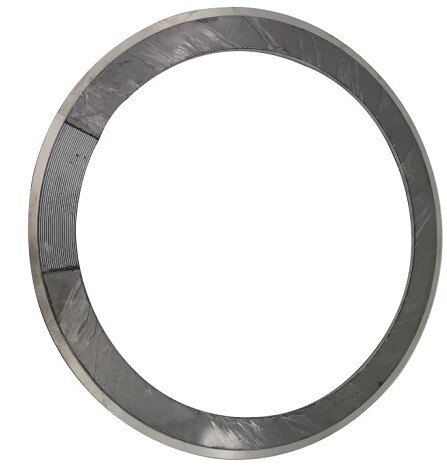
Understanding the structure of Kammprofile gaskets is key to explaining why they maintain reliable sealing under harsh conditions. Although the gasket appears simple, every part has a clear functional division. The main components include the metal core, corrugated structure, soft sealing layer, and optional outer guide ring. Below is a detailed description of each component.
The metal core is the backbone of the Kammprofile gasket, usually machined from a single piece of metal. Its thickness generally ranges from 2.5 mm to 4.5 mm, which determines the overall rigidity and compressive strength of the gasket.
The primary functions of the metal core are:
- Providing structural strength
- Defining the corrugated sealing profile
- Offering built-in compression limitation to prevent over-compression damage to the soft layer
Common metal core materials include carbon steel, 304 stainless steel, and 316 stainless steel. For special requirements, materials such as 321 stainless steel, Monel 400, Inconel 625, and Hastelloy C-276 are used for high-temperature or highly corrosive applications.
On both surfaces of the metal core, concentric circular corrugations are machined, typically 0.5 mm to 1.0 mm deep. These corrugations are the core design feature of Kammprofile gaskets.
When bolts are tightened, the corrugation peaks embed into the soft sealing layer, creating multiple concentric sealing lines that provide excellent blowout resistance. This design allows Kammprofile gaskets to accommodate uneven bolt loads better than other semi-metallic gaskets, ensuring reliable sealing even under high temperature and pressure conditions.
The soft sealing layer covers both sides of the metal core, primarily filling minor flange surface irregularities and forming the main sealing surface. Common soft sealing materials include:
- Flexible graphite
- Polytetrafluoroethylene (PTFE)
- Mica
Flexible graphite is the most commonly used material due to its high-temperature resistance, self-lubricating properties, and chemical compatibility. PTFE is suitable for highly corrosive chemical media, but its temperature resistance is relatively limited. Mica is used in extremely high-temperature environments. The thickness of the soft sealing layer is generally 0.5 mm to 1.0 mm per side. Too thick a layer risks over-compression and damage, while too thin a layer cannot adequately fill flange surface defects.
In addition to the metal core and soft layer, Kammprofile gaskets may also include an outer guide ring, typically made of carbon steel. The guide ring assists installation personnel in quickly positioning the gasket, ensuring alignment with the flange center.
The guide ring is usually designed with a loose fit so that thermal expansion of the metal core during operation does not introduce additional stress. While Kammprofile gaskets do not require a guide ring like spiral-wound gaskets, in some cases it helps during installation to ensure proper alignment.
Once the structure is understood, the next practical question is material selection for different operating conditions such as high temperature, corrosive media, and high pressure. Incorrect material choice can cause premature gasket failure, while correct selection ensures both sealing performance and cost-effectiveness. Material selection can be approached by considering the metal core, soft sealing layer, and common material combinations.
The metal core must be compatible with the process media:
- Carbon steel or 304 stainless steel for ordinary steam or oil
- 316 or 316L stainless steel for media containing chlorides or other corrosive agents
- Monel 400 for strong oxidizing acids
- Inconel 625 or Incoloy 825 for temperatures above 500°C or media containing corrosive gases such as H₂S
- Hastelloy C-276 for extremely corrosive environments, including strong acids, bases, or halide-containing processes
Soft layer selection depends on temperature and chemical environment:
- Flexible graphite: -200°C to 550°C, stable in steam, hydrocarbons, and most chemicals, unsuitable for strong oxidizers
- PTFE: highly chemically inert, almost resistant to all chemicals, temperature limit ~260°C, susceptible to cold flow under long-term high pressure
- Mica: can withstand over 1000°C, lower sealing performance, mainly for ultra-high-temperature applications where leakage tolerance is not critical
- Hydrocarbons or high-temperature steam: 316 stainless steel core + flexible graphite, up to 550°C
- Sulfur-containing gas environments: Incoloy 825 core + flexible graphite
- Strong corrosive chemicals: Hastelloy C-276 core + PTFE, temperature up to 450°C
- High-temperature steam: 321 stainless steel + flexible graphite
- Oxidizing acid environments: Monel 400 + PTFE, up to 260°C
Proper material selection allows the gasket to function effectively. However, Kammprofile gaskets are preferred not only for their diverse material options but also for their outstanding overall performance in sealing, pressure and temperature resistance, and longevity. The five main advantages are described below.
The corrugated metal core embeds into the soft sealing layer under compression, forming multiple concentric sealing lines. This is more reliable than a single planar seal. Even if the flange surface has minor scratches or unevenness, the soft layer fills these defects to maintain sealing integrity. The rigid metal core prevents over-compression, while the corrugated structure enhances blowout resistance, making the gasket resistant to sudden pressure spikes.
The solid metal core provides high mechanical strength, allowing it to withstand significant bolt loads and internal pressure. The combination of metal and soft sealing materials ensures stable performance across a wide temperature range. During thermal cycling, the metal core can recover and re-establish sealing pressure, a feature not easily achieved by many flexible gaskets.
The metal core is highly wear- and corrosion-resistant, rarely damaged under normal conditions. While the soft layer ages over time, the metal core can often be reused, requiring only soft layer replacement. This reduces long-term maintenance costs and replacement frequency. Compared to fully metallic or traditional non-metallic gaskets, Kammprofile gaskets maintain longer-term stability in harsh chemical, steam, and hydrocarbon environments.
The rigid metal core prevents deformation during handling and installation. No special tools are required, and normal flange assembly procedures are sufficient. The stiffness also facilitates alignment with bolt holes, reducing installation time. For large heat exchangers or pipeline flanges, quick gasket replacement minimizes downtime and improves production efficiency.
Kammprofile gaskets are manufactured and tested according to ASME, DIN, and API standards, ensuring consistent quality across industrial applications. For oil, petrochemical, and power industries, compliance with standards ensures both technical reliability and safety certification.
- Oil and Gas Industry: Flange connections in pipelines, valves, compressors, and separators require leak-free sealing. Kammprofile gaskets are preferred due to reliable sealing and high pressure resistance.
- Petrochemical and Refining Industry: Core equipment like heat exchangers, reactors, and pressure vessels operate under high temperature and pressure with flammable, explosive, or corrosive media. Kammprofile gaskets maintain long-term sealing in these harsh conditions, reducing maintenance and ensuring continuous operation.
- Power Industry: In power plants, especially thermal power, gaskets in boilers, turbines, and steam piping must withstand long-term high-temperature, high-pressure steam. Kammprofile gaskets’ long lifespan reduces downtime and improves efficiency.
- Chemical Processing Industry: Many chemical processes involve highly corrosive or high-temperature media. Proper metal core and soft layer combinations allow Kammprofile gaskets to meet these requirements safely.
- Large Flange Connections: For flanges larger than 24 inches, spiral-wound gaskets may warp or blow out. Kammprofile gaskets with solid metal cores maintain stable sealing. Some manufacturers provide ring-type conversion gaskets to adapt standard sealing solutions for raised-face flanges.
- Structural Differences: Spiral-wound gaskets are made of alternating metal and non-metal layers, usually with inner and outer rings. Kammprofile gaskets feature a solid metal core with soft layers, offering higher rigidity. Guide rings are optional.
- Performance Comparison: Kammprofile gaskets have multiple sealing lines and superior blowout resistance. They recover sealing pressure after thermal cycling, unlike spiral-wound gaskets, which are prone to stress relaxation and leakage.
- Cost and Supply: Spiral-wound gaskets are mature, mass-produced, cheaper, and readily available. Kammprofile gaskets are custom-made, more expensive, and have longer lead times. The metal core is reusable; the soft layer must be replaced.
- Suitable Applications: Kammprofile gaskets are ideal for large flanges, high-pressure/temperature heat exchangers, critical pipeline connections, and applications demanding high sealing reliability. Spiral-wound gaskets are better for small flanges, standard ASME B16.5 flanges, and cost-sensitive applications. Kammprofile gaskets require flat, defect-free flange surfaces; spiral-wound gaskets tolerate more imperfections.
Kammprofile gaskets are robust, reliable industrial sealing elements. Their combination of solid metal core and soft layers provides excellent sealing under high pressure, high temperature, thermal cycling, and large flange conditions. The corrugated structure forms multiple sealing lines, while the metal core resists compression and recovers after thermal expansion. Their versatility and performance make them widely used in oil and gas, petrochemical, power, and chemical industries.
Compared to spiral-wound gaskets, Kammprofile gaskets offer superior blowout resistance, thermal recovery, and reusability, but at higher cost and with stricter flange requirements. Selection should consider operating conditions, flange size, surface quality, budget, and maintenance strategy.
For large heat exchangers, high-pressure/high-temperature pipelines, critical equipment connections, and systems requiring long-term reliability, Kammprofile gaskets are a preferred choice. For smaller flanges, standard conditions, or cost-sensitive applications, spiral-wound gaskets may be a more economical option. Correct selection, proper flange preparation, and standardized installation are essential for ensuring long-term sealing performance.
